MyRank

Click here to go to MyRank

Sunday, January 29, 2017

Clock Puzzle 2


Puzzle-1: Where should the hour hand point to on the bottom clock?
Puzzle-2: What time should the bottom clock show?
Puzzle-3:  Where should the hour hand point to on the bottom clock?
Puzzle-4: What time should the last watch show?
Puzzle-5: Where should the hour hand point to on the bottom clock?

Evaluation and Algebric of Limits

The algebra of limits: Let f and g be two real functions with domain D. We define four new functions f ± g, fg, f/g on domain D by setting

(f ± g) (x) = f(x) ± g(x), (fg) (x) = f(x) g(x)

(f/ g)(x) = f(x)/ g(x), if g(x) ≠ 0 for any x ϵ D.

Let  if l and m exist, then

1. .

2. .

3. , provided.

4. , where K is constant.

5. .

6. .
7. f (x) ≤ g (x) for every x in the deleted nbd of a, then .

8. f(x) ≤ g (x) ≤ h for every x in the deleted ndb of a and   then 

9..

In particular:

Evaluation of limits: In the previous sections, we have discussed the notion of left hand limit (LHL), right hand limit (RHL) and the existence of the limit of a function f (x) at a given point. In the evaluation of limits, it is assumed that  always exists i.e., .
Left Hand and Right Hand Limit
In this section, we will discuss various methods of evaluating limits. To facilitate the job of evaluation of limits we categorize problems on limits in the following categories:

(i) Algebraic limits

(ii) Trigonometric limits

(iii) Exponential and logarithmic limits

Saturday, January 28, 2017

Dayanand Sagar University (DSU) 2017 Notification Released

What is DSU?

Dayanand Sagar University (DSU) is a private university located at Hongasandra Village, Begur Hobli, Bengaluru, Karnataka. DSU inviting applications from the candidates who wants to join in DSU for admission into B.Tech programmes for the academic year 2017 through Dayanand Sagar Admission Test (DSAT)-2017.

Important Dates:

Commencement of online registration of application
03.01.2017 Time: 10:00 am
Last date for submission of application
Tentatively 15 days before to the DSAT exam
DSAT-2017
23rd - April - 2017, 29th - April - 2017, 10th - May - 2017, 14th - May - 2017, 23th - May - 2017

Eligibility:

1. B.Tech - Computer Science & Engineering
2. B.Tech - Electronics & Communication Engineering
3. B.Tech - Mechanical Engineering
4. B.Tech - Computer Technology
(i) Pass in PUC/ 10+2 examination with Physics and Mathematics as compulsory subjects along with one of the Chemistry/ Biotechnology/ Biology/ Computer Science/ Electronics/ Technical Vocational subjects and obtained at least 45% marks (40% in case of candidate belonging to SC/ST & OBC category) in the above subjects taken together, of any Board recognized by the respective State Governments/ Central Government/ Union Territories or any other qualification recognized as equivalent there to.
(ii) Good score in DSAT or CET/ COMEDK or any other equivalent examination conducted by recognized Institute/ Agency.

Exam Pattern:

DSAT-2017 Test consists 75 questions based on CBSE +1 and +2 syllabus.

Mode of Exam: Pen and Paper Based

Riddles 4 (With Answers)

Riddle 1:  If you throw a red stone into the blue sea what it will become?

Answer: It will Wet or Sink as simple as that.

Riddle 2:  What looks like half apple?

Answer: The other half.

Riddle 3:  What can you never eat for breakfast?

Answer: Dinner.

Riddle 4:  What happened when wheel was invented?

Answer: It caused a revolution.

Riddle 5:  Bay of Bengal is in which state?

Answer: Liquid State.

Imperfections in Solids

Defects in Crystals: In a perfect crystal all the particles are present at their respective positions. However, no crystal is perfect, every crystal is associated with some deviations. These deviations are called defects (or) imperfections.

These are mainly two types.
  • Stoichiometric defects
  • Non- Stoichiometric defects
Stoichiometric defects: The compounds in which ratio between number of cations and number of anions is exactly to the ratio indicated by the formula are called Stoichiometric compounds.

These are the following types:
  • Schottky defect
  • Frenkel defect
  • Interstitial defects
  • Vacancy defects
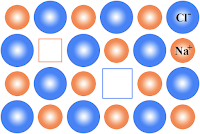
a. Schottky defect:
 This is arises due to missing of set of cations and anions leaving behind a pair of Holes.
 This is observed in ionic compounds with high coordination numbers.
⇒ This is observed in ionic compounds in which the sizes of anions and cations are almost equal.
Ex: Nacl, KCl, NaBr, CsCl etc….
Schottky defect
Consequences of Schottky defect:
 As the number of ions decreases as a result of this defect, the mass decreases whereas the volume remains the same. Hence density of the solid decreases.
 The crystal begins to conduct electricity to a small extent by ionic mechanism.
 The presence of too many voids lowers lattice energy and the stability of the crystal.

b. Frenkel  Defect: This arises due to missing of an ion from its correct lattice site and occupies an interstitical site.
This is observed mainly in:
i. Ionic compounds with low coordination number.
ii. Ionic compounds in which sizes of cations and anions differ largely.
Ex: AgCl, AgBr, AgI, ZnS etc……..
Frenkel  Defect
Consequences of Frenkel defect:
⇒ As no ions are missing from the crystal lattice as a whole, therefore density of the solid remains the same.
⇒ The closeness of like charges tends to increases the dielectric constant of the crystal.
⇒ The crystal conducts electricity to a small extent by ionic mechanism.

c. Interstitial defect:
⇒ This type of defect is caused due to the presence of ions in the normally vacant interstitial sites in the crystals.
 Interstitial impurity atoms are much smaller than the atoms in the bulk matrix.
 Interstitial impurity atoms fit into the open space between the bulk atoms of the lattice structure.
⇒ An example of interstitial impurity atoms is the carbon atoms that are added to iron to make steel. Carbon atoms, with a radius of 0.071 nm, fit nicely in the open spaces between the larger (0.124 nm) iron atoms.
Interstitial defect
d. Vacancy defect:
1. Vacancies are empty spaces where an atom should be, but is missing.
2. They are common, especially at high temperatures when atoms are frequently and randomly change their positions leaving behind empty lattice sites.
3.In most cases diffusion (mass transport by atomic motion) can only occur because of vacancies.
Vacancy defect

Thursday, January 26, 2017

AP EAMCET 2017 Dates Released

AP EAMCET 2017 Logo

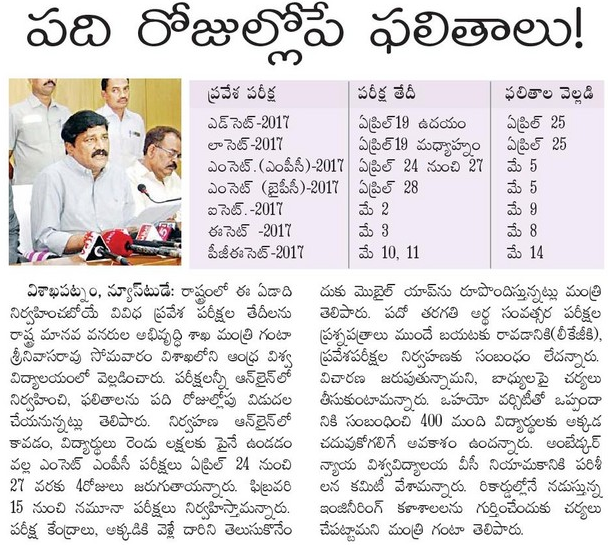
AP COMMON ENTRANCE TEST (AP EAMCET) dates has been released

M.P.C 24th to 27th April 2017

Bi.P.C 28th April 2017

Exam is conducted only online and the results will be released within 10 days from the day of exam said by HRD Minster of AP Ganta Srinivasa Rao.

AP EAMCET 2017